Building a Weather & Marine API Wrapper
June 15, 2025 • 3 min read
Yesterday, I started building a custom API wrapper—initially just for myself.
My goal was to use it in two very different but connected projects: one geolocation-based, and the other for the upcoming Azores.Surf website. I began testing on a private webcam project I use to track weather conditions for photography. It made perfect sense—I'm always checking it anyway.
Balancing Fresh Data with Practical Constraints
The initial requirement seemed simple: integrate weather data for multiple points across the Azores islands. But, as any developer knows, the devil is in the details. My testbed was my private webcam site—a perfect lab since I already use it to monitor weather for photography planning. The first challenge quickly emerged: API request optimization. Real-time data is great, but making individual API calls for every geo-point would be inefficient and potentially expensive.
So, instead of treating each location as a separate entity, I implemented an intelligent clustering system based on the geography of the Azores.
- For larger islands, webcams are grouped by district. Weather conditions within a few kilometers are often nearly identical, and the number of available weather stations supports this logic.
- For smaller islands, where district-level data doesn’t exist, the system defaults to a single island-wide point.
This approach ensures full coverage while drastically reducing API calls—without sacrificing meaningful accuracy.
Caching Strategy
No modern API wrapper is complete without intelligent caching. I implemented a 3-hour caching interval—a sweet spot that balances data freshness with API efficiency. This interval works exceptionally well with both weather and marine forecast APIs, as a single call provides hourly forecasts for 5 days plus current conditions. For most use cases, this granularity is more than sufficient. Without optimization, a site with 20,000 daily visitors checking 5 locations would trigger 200,000 API calls per day. With clustering and caching, that drops to around 16 calls per day (8 endpoints every 3 hours)—a 99.9% reduction.
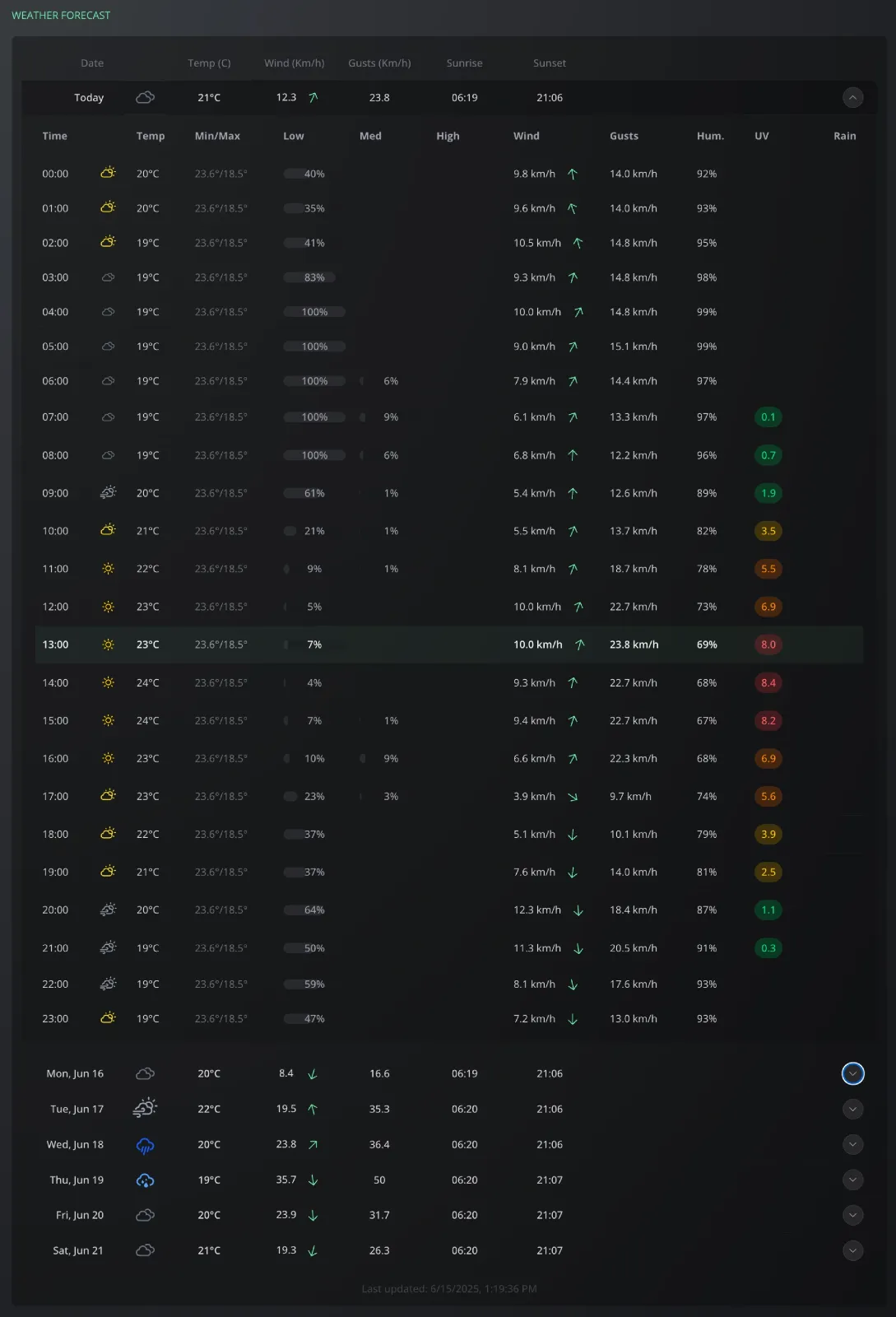
Weather Widget
I'm curating the weather data based on what I actually care about as a photographer. Key elements like sunrise and sunset are prioritized. The system will continue evolving as I refine the data hierarchy through real-world use and feedback.
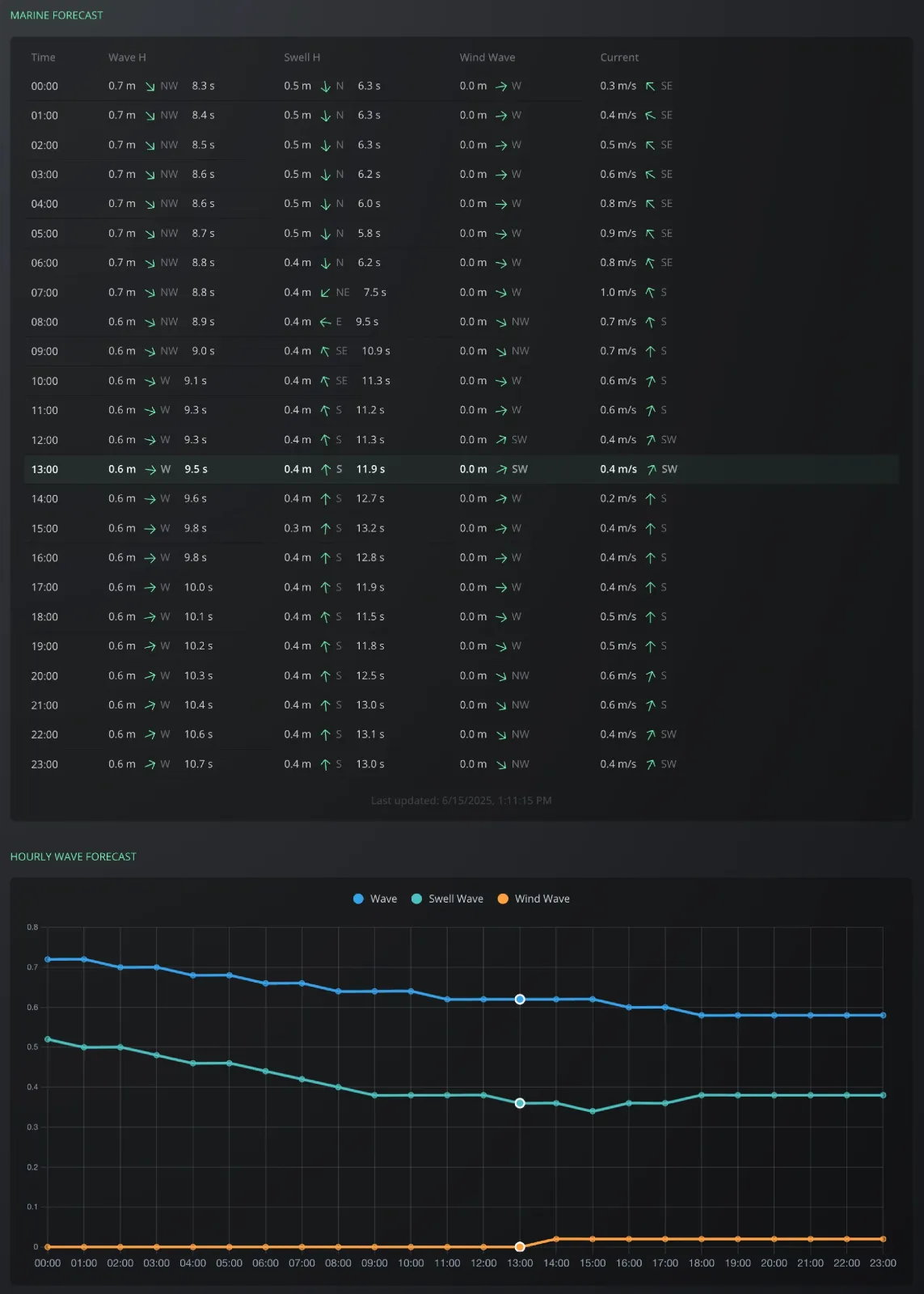
Marine Widget
Recognizing that weather alone doesn't tell the complete story for coastal activities, I integrated marine forecasting with its own set of challenges:
- Unique Positioning: Marine forecasts don’t align with weather stations, so I manually mapped beaches and swim areas to their closest marine points.
- Contextual Relevance: Marine data is only fetched for coastal areas (beaches, swim spots, surf zones). Inland locations are skipped, avoiding unnecessary API usage.
Verifying Accuracy
Before considering this wrapper production-ready, I'm conducting extensive accuracy testing by comparing forecasts against real-world conditions and cross-referencing with established weather services. This validation phase is crucial—accuracy trumps all other optimizations. If the free weather API doesn't meet accuracy standards, I'm prepared to restart the evaluation process with alternative providers. The constraint of maintaining zero cost for this passion project adds complexity but also drives creative optimization solutions.
AI-Enhanced Surf Predictions
This is where it gets fun. While training my own weather model isn’t realistic, I’m experimenting with AI-supported logic systems to interpret surf conditions.
- Condition-Specific Logic: Not just general forecasts—I'm coding logic that understands surf conditions for specific beaches.
- Beach-Specific Optimization: Factoring in beach orientation, local terrain, and historical patterns for ultra-local assessments.
I’m feeding marine data to AI systems to see how well they can analyze current conditions. Early tests are promising—AI is producing surprisingly accurate surf insights.
The Bigger Picture
This API wrapper is more than just a tech solution. It’s a personalized weather system—a response to the unique geography of the Azores, API constraints, and the real needs of outdoor users.
The modular design means lessons here will directly influence the broader Azores.Surf platform. And whether or not the AI surf prediction takes off, it's exactly the kind of experiment that emerges when limitations push you toward smarter, cleaner systems.